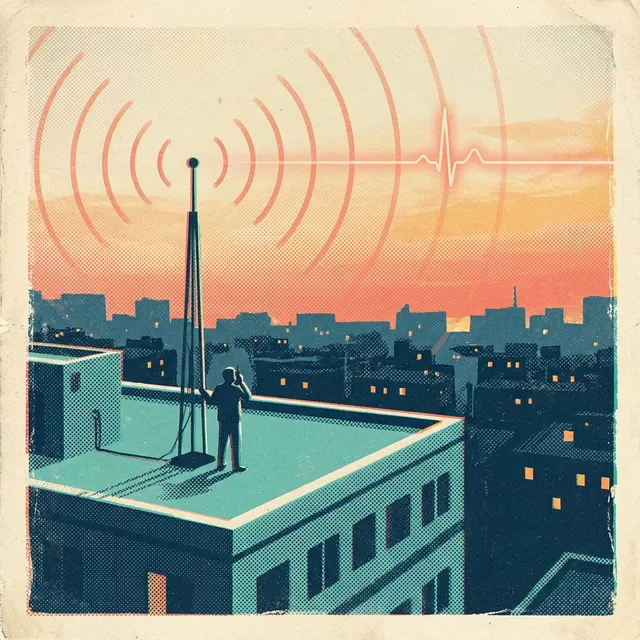
Behind the song · telemetry · networking · cardiology
Mapping the Wireless Grid in Telemetry
Take A pulses with four-on-the-floor energy, honoring the radio frequencies and antenna grids that track cardiac rhythms.
In short
- Medical telemetry networks require robust antenna distribution to prevent data packet drops across hospital units.
- Technicians routinely filter line noise and maintain transmitter battery integrity to protect real-time cardiac traces.
- The song translates high-frequency radio coordination into a driving electronic dance celebration.
Inside modern acute care facilities, wireless telemetry packs allow ambulatory patients to walk hallways while central nursing consoles track continuous electrocardiogram traces. The invisible infrastructure behind this freedom requires intricate radio frequency planning, distributed antenna networks, and constant maintenance. When patient packs transmit at 600 megahertz, clinical engineering teams must ensure zero packet drops occur across concrete barriers and crowded wards. Take A of Telemetry turns this complex wireless ecosystem into a high-energy dance track, celebrating the technicians who harmonize biomedical hardware with airborne data streams.
Where the song came from
The idea behind the track originated from the technical challenges inherent in managing distributed telemetry arrays across expansive hospital architecture. Biomedical departments spend substantial field hours hunting down radio interference, filtering out ambient electrical noise, and replacing exhausted battery packs before critical telemetry monitoring fails. The lyrics directly highlight the craft of tuning frequency gains and eliminating sixty-cycle interference from diagnostic traces. The track captures how clinical mobility depends entirely on wireless telemetry reliability, framing every clean QRS complex on the central monitor as a quiet technical victory.
Zero drop effects on the antenna gridRe -micro -vote secrets that the body hid I got thediagnostic terminal in my handConducting this orchestra across the hospital land
Maintaining accurate physiological monitoring requires rigid adherence to calibration procedures and electrical safety margins. According to biomedical literature on clinical engineering practice published in Biomedical Instrumentation & Technology, resolving phantom alarms and artifact noise demands meticulous troubleshooting at the sensor, transmitter, and receiver levels. Transmitters must endure constant physical drops, disinfectant wipe-downs, and lead flex wear without losing microvolt signal sensitivity. By tracking signals through hallways and stairwells, biomeds preserve the unbroken link between recovering patients and clinical response teams.
The musical arrangement reflects this clinical precision through driving four-on-the-floor kicks, bright neon synthesizers, and sidechained basslines. Clocking in at a brisk tempo, the production evokes an active nursing floor moving in rhythm with monitor sweeps and clean telemetry readouts. The song honors the engineering vigilance that keeps wireless physiological data flowing effortlessly through the air, turning hospital communication standards into an exuberant celebration of technology safeguarding human life.
Sources & references
- "No Problem Found" Service Calls - Keep Digging, AAMI (Biomedical Instrumentation & Technology)
- Career Progressions in Healthcare Technology: Technician, Clinical Engineer, Leadership, AAMI (Biomedical Instrumentation & Technology)