Behind the song · bench-repair · troubleshooting · right-to-repair
"On the Bench" and the Discipline of Not Guessing
The funk-pop track follows a repair from tiny screws in a tray to a documented fix, and the parts-room verse points at a real friction in the field.
In short
- The song's method — label it, trace it, measure twice — mirrors real bench-repair discipline.
- The "search the parts room, call the crew" verse points at a real access problem: many manufacturers withhold service manuals and diagnostic software.
- Writing the fix down for the next technician is as much a part of the job as making it.
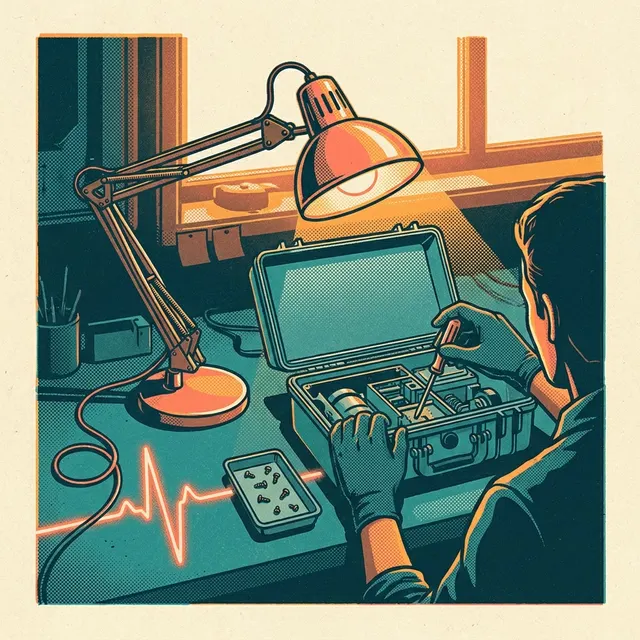
"On the Bench" is nu-funk built around a single scene: gloves on, lamp bright, a case laid open with tiny screws in a tray. It's one of two takes of the same song on the station, and this one plays the story straight — a methodical, unhurried account of what actually happens between "broken" and "fixed."
That unhurried pace is the song's real subject. Nothing in the lyric happens quickly — a lamp gets positioned, screws get sorted into a tray, a label gets read before anything is touched. Bench repair rewards exactly that kind of patience, since a device that's been opened up without a plan is usually harder to close back up correctly than it was to diagnose in the first place. Even the chorus keeps that pace: "check it, test it, bring it back" is sung as a full sequence every time, never shortened, as if skipping a step out loud would be as bad as skipping it on the bench.
Where the song came from
The idea is the bench itself: the discipline of reading the label, tracing the signal line, and refusing to guess. "Two by two we test the range, name the problem, make the change" is a fair description of real fault-isolation work — confirm the symptom, form a theory, test it, only then touch anything. The song treats patience as the actual skill, not a delay before the skill.
Read the label, check the listTrace the signal lineIf the answer hides somewhereWe'll give it time to shine
The verse about the parts room — "search the parts room, call the crew, match the model to the year" — is doing more work than it seems. Sourcing the right part is often the hardest part of a repair, not the diagnosis. An estimated 80 percent of medical device manufacturers deny hospitals direct access to diagnostic software and factory service manuals, which forces technicians to work from experience and improvisation rather than a manual, or pay a premium to bring the manufacturer in. "Measure twice, inspect the fit, make the pathway clear" reads differently once you know some of that pathway has to be built by hand.
Pass the notes, phrase the signReady for the next designWrite it down so the next hands knowThat's how good repairs grow
That closing idea — writing it down for the next technician — is the real ending of the song. A repair on the bench isn't finished when the device works again; it's finished when the next person who opens that case has a record to work from. Given how much of a repair can depend on improvised knowledge in the first place, thanks to that same access gap, a clear, written record of what actually worked becomes one of the only reliable manuals a bench technician can count on.